
World Biogas Association sets out global landfill gas solutions for COP31 Zero Waste and Methane Reduction agenda
New WBA position statement identifies practical policy, investment, technology and monitoring measures to cut methane emissions from landfills and unlock the value of landfill gas
The World Biogas Association (WBA) has launched a new position statement setting out practical measures to reduce methane emissions from landfill and maximise the climate and energy value of landfill gas (LFG), ahead of COP31 in Antalya.
The statement will form part of WBA’s contribution to the COP31 Zero Waste and Methane Reduction Action Agenda, translating the global focus on waste-sector methane into practical solutions that governments, landfill operators, investors and technology providers can implement.
Charlotte Morton, Chief Executive of the World Biogas Association says, “Landfill methane is one of the clearest examples of where climate ambition can be translated into action. We know how to capture landfill gas, we have technologies to measure and manage it, and we increasingly have the ability to turn it into renewable gas.
“Zero waste and landfill gas capture are not competing solutions. We need to prevent organic waste entering landfill in the first place, while simultaneously managing the methane from waste already in the ground. COP31 provides an opportunity to bring these two priorities together and accelerate implementation.”
WBA is calling on governments, cities, landfill operators, investors and technology providers to use COP31 to move from recognition of the landfill methane problem to implementation of proven solutions.
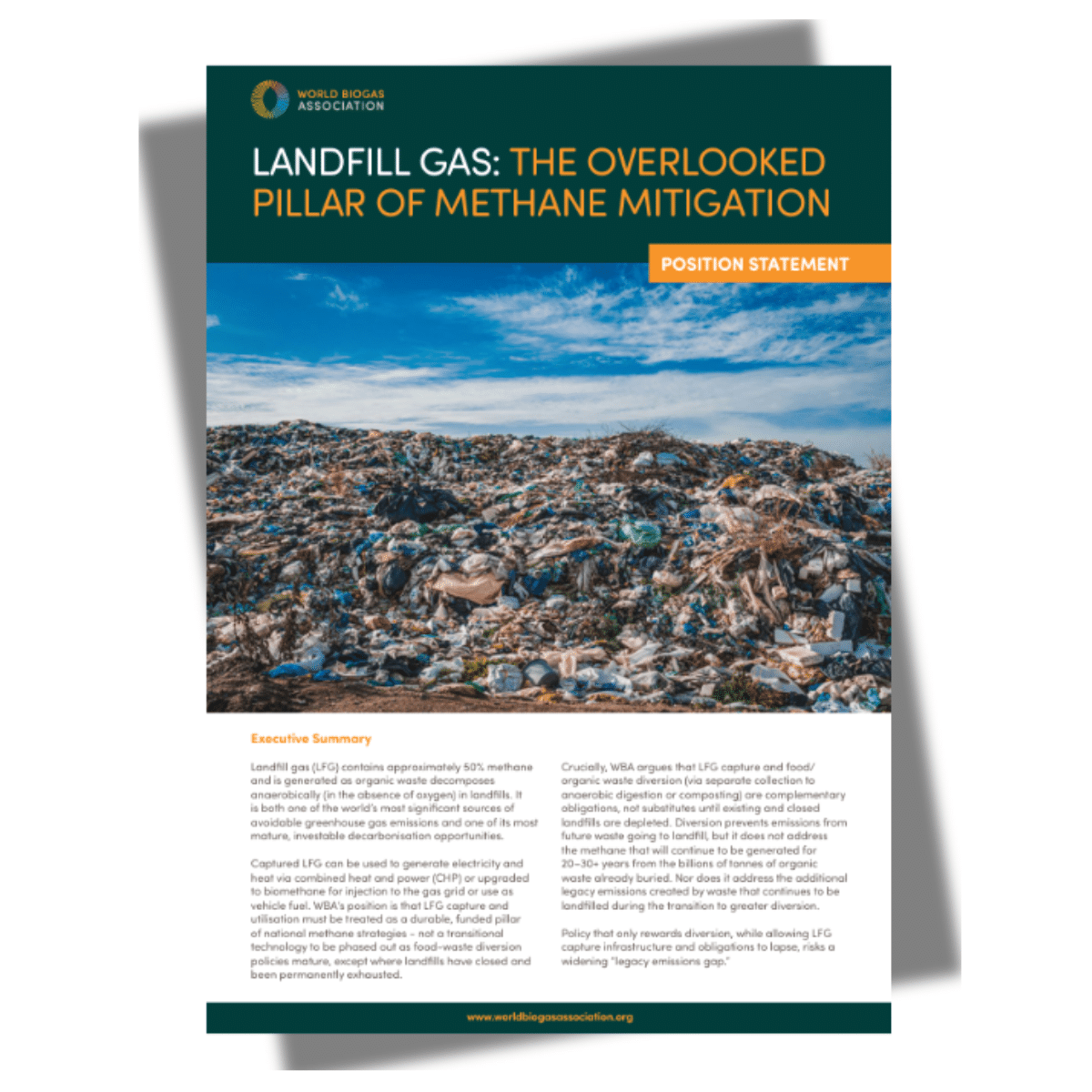
The WBA position statement, LANDFILL GAS: THE OVERLOOKED PILLAR OF METHANE MITIGATION, is available alongside a new COP31 Zero Waste and Methane Reduction resource hub, bringing together the evidence, technologies and policy recommendations needed to accelerate action.
A MAJOR METHANE OPPORTUNITY: Position Statement Insights
WBA estimates that maximising landfill gas capture globally could mitigate up to 760 MtCO₂e annually, the equivalent of removing ~165 million cars from the road every year, demonstrating the scale of the opportunity to make landfill methane reduction a core component of global climate action.
The need for action will persist even as countries accelerate waste diversion. Organic waste diversion prevents future landfill emissions, but waste already buried will continue generating methane for decades. Effective landfill gas capture is therefore needed alongside prevention, recycling, composting and anaerobic digestion to address both future and legacy emissions.
The UK illustrates the importance of aligning these policies. Government’s methane action plan recognises that landfill accounts for 81% of waste-sector methane emissions. However, Renewables Obligation support for landfill-gas electricity begins to end from 2027. This creates a need and an opportunity to establish a policy framework that maintains methane capture while enabling higher-value uses of landfill gas, including biomethane where technically and economically feasible. WBA is calling for landfill gas to be recognised as a methane-abatement resource, independently of policies designed to reduce future waste disposal.
Where gas quality and infrastructure allow, upgrading landfill gas to biomethane provides an established route to maintain methane capture while producing renewable gas.
In countries where uncontrolled dumping remains widespread, investment in engineered landfill infrastructure and gas capture can deliver immediate methane reductions while waste-management systems transition towards higher levels of prevention, recycling, composting and anaerobic digestion. Improved measurement of methane generation and capture can further strengthen project assessment, green-finance certification and confidence in emissions-reduction claims.
Together, these measures provide a practical pathway for governments, landfill operators, investors and technology providers to address methane emissions from waste already in the ground while accelerating the transition towards zero waste.
READ THE FULL LANDFILL GAS STATEMENT
EXPLORE THE NEW COP 31 ZERO WASTE AND METHANE REDUCATION RESOURCE HUB
– ENDS –
For further information, contact:
Jon Hughes | Head of Content/Editor in Chief | World Biogas Association
jhughes@worldbiogasassociation.org; +44 (0)20 3176 0590
Yamini Talwar | Communications Manager | World Biogas Association
ytalwar@worldbiogasassociation.org; + 44 (0)20 8434 5407
Notes to editors
About the World Biogas Association
Launched at COP22 in Marrakesh in 2016, the World Biogas Association (WBA) is the global trade association for the biogas, biomethane and anaerobic digestion sectors. WBA works with governments, industry and international organisations to accelerate the deployment of biogas solutions worldwide, supporting climate action, methane mitigation, renewable energy generation, and circular economic growth. Through its #MakingBiogasHappen programme, WBA is creating the conditions for sector growth through initiatives such as the Global Biogas Regulatory Framework (GBRF), which helps governments develop effective policy and regulatory environments, and ADCS International, the world’s first global certification scheme for biogas plants. Together, these initiatives advance the standards, certification systems, and best practices needed to support the safe, professional, and sustainable scaling of the sector worldwide. www.worldbiogasassociation.org