
#MakingBiogasHappen: From India’s opportunity to global action
Lessons from the World Biogas Association INDIA Congress 2026 on scaling performance, investment and impact – By Charlotte Morton OBE, Chief Executive, World Biogas Association
India has the potential. India has the policy.
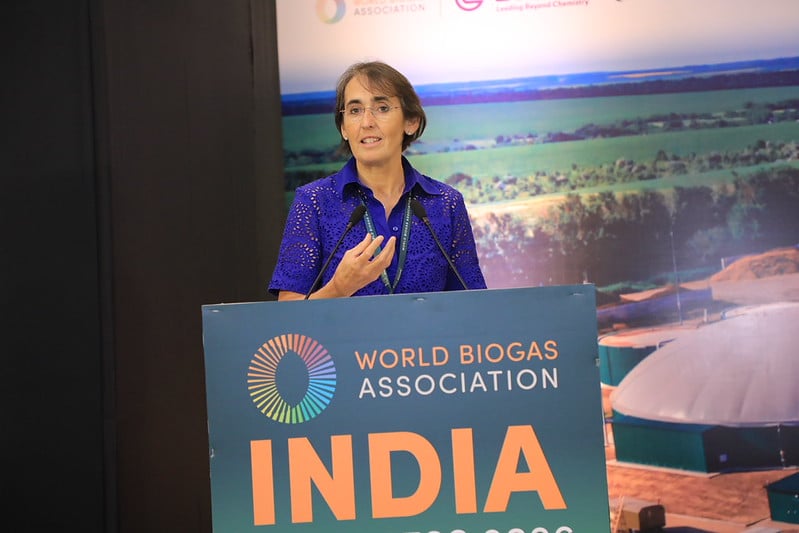
The next priority is performance. This was the message at the heart of the fourth World Biogas Association (WBA) INDIA Congress 2026, held in New Delhi on 8-9 October 2026.
India has the resources and ambition to build a thriving compressed biogas (CBG) industry. The challenge now is to translate that potential into reliable production, commercially viable projects, and measurable climate benefits. But this is not just India’s challenge.
As the global biogas sector enters its next phase, we must look beyond what technology can achieve in principle and focus on what it delivers in practice. The future of biogas will depend on our ability to turn ambition into sustained performance and to share the lessons that make it possible.
Growth means little without delivery
India’s CBG opportunity is significant. By converting agricultural residues and other organic wastes into valuable resources, biogas can strengthen India’s energy security, support rural economies, and contribute to the country’s Net Zero 2070 ambitions. Initiatives such as GOBARdhan provide an important policy foundation.
The next challenge is translating that ambition into projects that perform well and consistently throughout their operational lives. This requires us to look beyond individual plants and consider the entire value chain: feedstock availability and quality, technology, gas offtake, digestate management, operator skills and regulation.
Performance starts at the project-concept stage. A plant must be sited where it can secure sufficient feedstock of the right quality, reach reliable offtakers for its energy and digestate outputs, and accommodate the vehicle movements required throughout its operating life. These considerations must be matched by a plant design suited to the available feedstocks, intended outputs,, and local operating conditions.
If either the site or the design is wrong, operational and commercial performance will suffer. Designing projects to meet ADCS International (ADCSI) requirements from the outset provides a structured way to address these fundamentals early and build performance into the project rather than trying to correct weaknesses after commissioning.
A weakness in any one of these areas can undermine the performance and economics of a project.
We cannot scale biogas sustainably by focusing on capacity alone. We must build the conditions for reliable performance from the outset.
The real test begins when a plant starts operating
Some of the most valuable insights from the Congress came from discussions about the practical realities of running CBG plants.
At the CBG Developers Roundtable on Plant Performance – ADCS International, co-hosted by the World Biogas Association and the Indian Federation for Green Energy (IFGE), developers, operators and international experts explored challenges including feedstock quality, methane leakage and operator competencies.
In evolving supply chains, rejecting poor-quality feedstock may not always be feasible. Improving quality therefore requires adaptable processes, better source segregation and stronger engagement with farmers and suppliers. Methane management is equally important. Effective monitoring, leak detection and mitigation must become part of routine operations if we are to realise biogas’ full climate potential.
These challenges reinforce a common principle: performance depends not simply on the technology installed, but on the quality of everyday decisions, systems, and operator competence. Structured operator training is therefore essential. Competence is not just about having the practical skills to complete a task; it means understanding why it must be done, how it affects the wider process, and what the consequences may be if it is done incorrectly.
This understanding is also important for those making financial decisions about a plant. The lowest-cost option is not always the one that delivers the best value over the project’s life; sometimes additional investment in equipment, maintenance, monitoring or people is necessary to improve performance, reduce risk and protect long-term returns. Digital tools can help, but their value lies in whether they support better decisions and improve operational outcomes.
Good performance cannot be assumed. It must be measured and continually improved.
Investment confidence must be earned
Scaling the sector requires capital, but investment depends on more than ambitious targets or a pipeline of proposed projects. Investors need confidence in realistic production forecasts, secure feedstock, dependable offtake, competent operators, and credible risk management.
Bankability therefore begins long before finance closes. Stronger project design, sound operating models, and reliable performance data can help reduce uncertainty and build investor confidence.
We must also demonstrate environmental benefits credibly through robust measurement, reporting, and verification, supported by life-cycle assessment.
For policymakers, developers, and investors, the message is clear: projects must be designed around the outcomes they are expected to deliver, with the evidence to demonstrate those results.
What India can teach the world
The challenges India is addressing are shared by biogas markets worldwide. International collaboration can help countries learn faster, share practical solutions, and avoid repeating the same mistakes.
Through WBA’s #MakingBiogasHappen programme, we are working to support this progress. The Global Biogas Regulatory Framework (GBRF) provides nine pillars of adaptable best-practice policy and regulation, while the Anaerobic Digestion Certification Scheme International (ADCSI) provides an 11-module certification framework to help ensure plants are designed, built and operated well, with minimum health and safety standards. Its modules include biomethane upgrading and life-cycle assessment.
These frameworks provide practical foundations for strengthening policy, standards, and operational practices while allowing approaches to be adapted to local circumstances.
India can benefit from international expertise, just as the global sector can learn from India’s scale, agricultural resources and experience in CBG development.
The goal is not simply to transfer knowledge across borders, but to turn shared experience into better-performing projects everywhere.
The next decade must be defined by delivery
As WBA celebrates ten years since its launch at COP22 in Marrakesh in 2016, the priority for the next decade is to turn the sector’s growing recognition into sustained results.
Progress must be measured by reliable renewable gas production, methane emissions avoided, waste treated, and value created for farmers and communities. Achieving this requires governments, industry, investors and technical experts to work together, measure performance rigorously and continually improve how projects are developed and operated.
I would like to extend my sincere thanks to everyone who joined us in New Delhi, shared their expertise, contributed to the discussions and supported the World Biogas Association INDIA Congress 2026. Our speakers, delegates, partners, sponsors and wider community helped make the Congress a valuable opportunity for collaboration, and I am grateful to everyone working to advance the sector in India and around the world.
The conversations in New Delhi reinforced my conviction that India’s biogas journey has significance far beyond its borders.
By combining national ambition with operational excellence, investment confidence and international collaboration, India can help demonstrate what performance-led growth looks like at scale.
The next decade of biogas cannot be defined by ambition alone. It must be defined by delivery: plants that perform, investments that endure, and environmental benefits that can be demonstrated. India has an opportunity to help show what this looks like at scale. WBA’s role is to bring countries and industry together to turn that opportunity into progress.
That is how we will keep #MakingBiogasHappen