

Scaling Municipal Solid Waste-to-Biogas Projects in India Through a Feedstock-First Rethink of the Value Chain
This paper has been prepared by the Chintan Research Foundation (CRF) as a discussion paper leading to the “World Biogas Association (WBA) INDIA Congress 2026.
India’s Energy Transition and Making a Case for Biogas
India’s energy system is undergoing a structural transformation driven by two simultaneous imperatives: ensuring energy security and meeting decarbonisation commitments. While the ‘electrification first’ strategy has gained worldwide consensus, electricity currently accounts for only a fraction of India’s final energy consumption, an estimated 21 per cent as of 2025, projected to rise to nearly 60 per cent by 2070 under the National Institution for Transforming India (NITI) Aayog’s (2026) net zero scenario. Significant portions of transport, fertiliser production, industrial process heating, long-distance freight, aviation, shipping, and several chemical industries continue to depend on energy-dense molecular fuels. The structural nature of this molecular dependence was made explicit in March 2026, when the Ministry of Petroleum and Natural Gas (MoPNG) invoked the Essential Commodities Act, 1955, to ration natural gas during the West Asian crisis (MoPNG 2026). Domestic piped gas and transport compressed natural gas (CNG) were held at 100 per cent of historical consumption while other sectors absorbed cuts, but fertiliser plants still had guaranteed a protected 70 per cent of their six-month average supply, underlining how load-bearing gas remains for fertiliser production (MoPNG 2026).
Consequently, striking a balance between energy security and decarbonisation in the Indian context requires a framework of ‘electrons wherever possible and molecules where indispensable’. Among renewable molecules, biomethane, commercially marketed as compressed biogas (CBG) in India, occupies a distinctive position because it simultaneously addresses energy security, waste management, methane mitigation, nutrient recycling, and rural income generation. This explains why the government has built an increasingly wide set of fiscal and regulatory incentives specifically around it, including central financial assistance, customs duty concessions on plant machinery, and the inclusion of CBG financing under Reserve Bank of India (RBI) Priority Sector Lending (RBI 2020).
Biogas is a combustible gas mixture produced by the microbial anaerobic degradation of organic matter, such as cow dung and agricultural residues, under oxygen-free (anaerobic) conditions. Typically, raw biogas contains approximately 50–70 per cent methane (CH₄), 30–50 per cent carbon dioxide (CO₂), and trace quantities of hydrogen sulphide (H₂S), moisture, ammonia, siloxanes, and other impurities. This molecule can substitute for fossil fuels such as liquefied petroleum gas (LPG), CNG, and diesel in both heat and power generation and as a vehicle fuel. Owing to its relatively low methane concentration and presence of contaminants, raw biogas has limited applications and is primarily used for decentralised cooking, heating, or electricity generation.
CBG, also referred to as biomethane or Bio-CNG, is produced by upgrading raw biogas through the removal of CO₂, H₂S, moisture, and other contaminants, thereby increasing methane purity to approximately 95–98 per cent (IOCL, SATAT Scheme FAQ). The purified gas is subsequently compressed to high pressure (typically 200–250 bar), enabling storage, transportation, and utilisation in applications traditionally served by CNG. As biomethane meets the quality specifications for natural gas, CBG can be injected into natural gas pipelines, supplied through city gas distribution (CGD) networks, or used directly in transport, industrial heating, commercial establishments, and decentralised energy systems. Its chemical similarity to natural gas also permits utilisation without significant modifications to downstream infrastructure or end-use equipment.
Within this broader case for biogas, municipal solid waste (MSW) occupies a distinct position. It is an organic feedstock with immense potential for valorisation into CBG and is directly linked to the sanitation and ‘clean cities’ mandate that anchors the Swachh Bharat Mission-Urban 2.0 (SBM-U 2.0). It is under this mandate that the government provides additional central assistance (ACA) specifically for MSW-based CBG plants, delineating MSW as a distinct feedstock category from agricultural or cattle-dung-based biogas (MoPNG 2023c). MSW is also the most institutionally under-tapped of India’s major feedstock streams relative to its resource base, and the one whose mismanagement carries the most visible public cost – open dumping, landfill fires, leachate contamination, and methane emissions – in dense urban settings. Biogas production via anaerobic digestion offers a dual solution: waste management alongside renewable energy production. This aligns with Sustainable Development Goal (SDG) 7 (clean energy), SDG 11 (sustainable cities), and SDG 13 (climate action).
Therefore, biogas can be positioned as a strategic energy resource, a renewable source of carbon, a lever for energy security, and a tool for methane mitigation and nutrient recycling, all at once. However, despite schemes such as Galvanising Organic Bio-Agro Resources Dhan (GOBARdhan), Sustainable Alternative Towards Affordable Transportation (SATAT), and the National Bioenergy Programme (NBP), its adoption lags well behind its potential. The scale of this gap, and the government’s own diagnosis of it, is visible in the policy record. SATAT was launched in October 2018 with a target of setting up 5,000 CBG plants by 2023–24, but as of 31 October 2022, only 38 CBG plants had actually been commissioned against 3,694 letters of intent (LOIs) issued (MoPNG 2022). This is a substantial gap. In light of this, on 6 August 2026 the Union Cabinet approved a restructured, ten-year ₹23,731 crore GOBARdhan National Circular Bioenergy Scheme, consolidating SATAT and four other CBG-related schemes into a single framework with assured offtake, administered pricing, and dedicated credit guarantees specifically to close the implementation gap between registered capacity and commissioned plants (Press Information Bureau [PIB] 2026a), a signal that the shortfall lies in implementation, not technology.
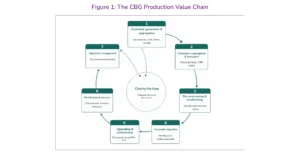
For this study, the CBG value chain has been dissected in depth to form the analytical framework used to identify at which point of the value chain (Figure 1) – technical, logistical, institutional, or financial – the constraints become binding. This study therefore analyses MSW-to-CBG as a six-stage value chain: (i) feedstock generation and aggregation; (ii) collection, segregation, and transport; (iii) pre-processing and feedstock conditioning; (iv) anaerobic digestion and biogas capture; (v) gas upgrading and compression; and (vi) distribution and end use. A parallel digestate pathway extends from digestion to biofertiliser processing and agricultural application. For each stage, the analysis considers four dimensions: the principal technical constraint, the institutional actor responsible for managing it, the associated financial or commercial risk, and the policy instrument required to address that risk.
This allows the study to distinguish between constraints that can be solved through engineering and those that require changes in institutional design, contracting, or market architecture. The efficient integration of each stage is essential as it determines overall plant economics, methane recovery, environmental performance, and commercial viability. For MSW specifically, the first two stages – aggregation and segregation– were found to be a binding constraint on the entire chain, as the contamination introduced before the feedstock reaches the digester cannot be economically removed downstream without derating plant capacity or inflating operating expenditure (OPEX).
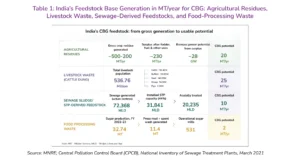
In addition to the variability in feedstock production, geographic distribution also varies significantly across the country (Figure 2). This makes it imperative to analyse the feedstock availability in a particular region for its valorisation. For instance, as per the National Biomass Atlas’s state- and crop-wise breakdown, Uttar Pradesh generates the largest gross crop residue volume, followed by Punjab, Haryana, Gujarat, Madhya Pradesh, Karnataka, Andhra Pradesh, and Tamil Nadu as the next tier of surplus-residue states. Punjab and Haryana primarily dominate paddy straw specifically (the feedstock most linked to stubble-burning and to CBG plant-siting decisions). Meanwhile, West Bengal holds the largest cattle population nationally (per the 20th Livestock Census), overtaking the earlier leaders, Uttar Pradesh, Rajasthan, Madhya Pradesh, and Bihar. For sewage treatment plants (STPs), Maharashtra, Gujarat, Uttar Pradesh, Delhi, and Karnataka were found to together account for roughly 60 per cent of India’s total installed STP capacity. On the MSW side, only five states/union territories (UTs) (Andaman & Nicobar Islands, Chhattisgarh, Lakshadweep, Odisha, and Tripura) had achieved 100 per cent source segregation as of the same Central Pollution Control Board (CPCB) assessment, even though 14 states/UTs had achieved 100 per cent collection.
Feedstock Suitability for CBG Deployment in Cities
The above section on national estimates of biomass availability points to India’s extensive resource base. However, this does not directly translate to feedstock that can support a commercially viable CBG plant. According to the National Biomass Atlas developed by the Sardar Swaran Singh National Institute of Bioenergy (SSS-NIBE) for the MNRE, India’s surplus biomass availability is estimated at 230 million metric tonnes per annum, with an associated biomass power potential of about 28 GW (SSS-NIBE n.d.). This, however, tells us little about whether a specific city’s waste stream is bankable. Being bankable means being reliably aggregable, transportable, processable, and deliverable at predictable quality and cost over a plant’s operating life. The distinction between resource potential and bankable feedstock is thus central to project-level planning, since spatial concentration, seasonality, moisture, contamination, collection cost, competing uses, and storage requirements determine commercial viability far more than aggregate tonnage does. Feedstock streams differ sharply on these dimensions (Table 2).
To read more, Please download the PDF.