
A Decade of Transformation: How Biogas Has Evolved from a Niche Technology to a Global Climate Solution
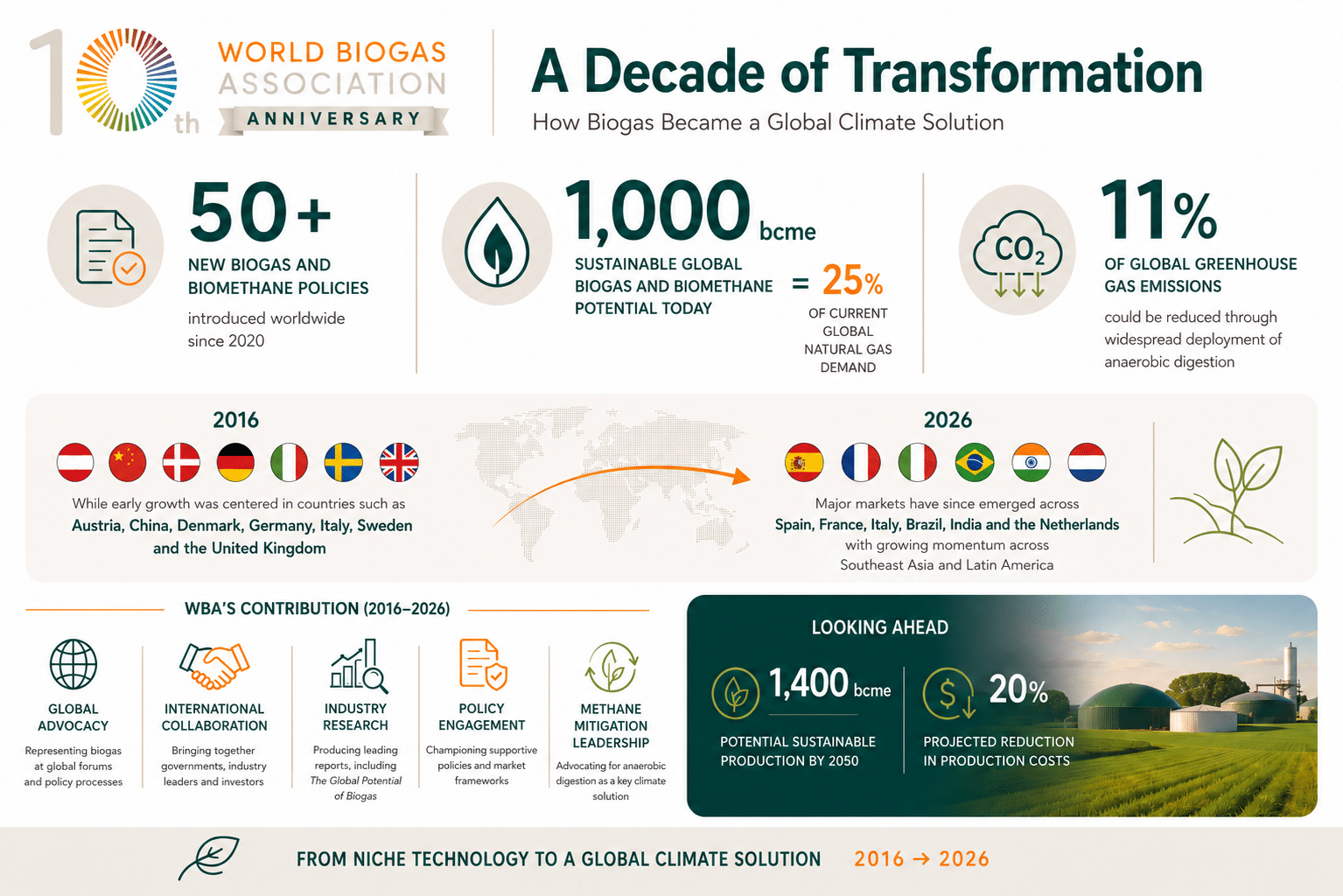
- WBA celebrates its 10th anniversary in 2026, marking a decade that has seen biogas evolve into a globally recognised climate, energy, and circular economy solution.
- Global momentum is growing, with 50+ new biogas and biomethane policies introduced since 2020 and major expansion across key international markets.
- Biogas has the potential to meet 25% of current global natural gas demand and reduce up to 11% of global greenhouse gas emissions.
As the World Biogas Association (WBA) celebrates its 10th anniversary in 2026, the global biogas sector stands at a defining moment.
Ten years ago, biogas was largely concentrated in a handful of European markets. Today, it is increasingly recognised as a vital solution for climate action, methane mitigation, energy security, waste management, and circular economy development.
Since its founding in 2016, WBA has worked to elevate biogas on the international stage, bringing together policymakers, industry leaders and investors while advocating for supportive policies and greater recognition of the sector’s role in delivering net-zero ambitions.
The industry’s growth has accelerated significantly. According to the International Energy Agency (IEA), more than 50 new biogas and biomethane policies have been introduced globally since 2020.
While early growth was centered in countries such as Austria, China, Denmark, Germany, Italy, Sweden and the United Kingdom, major markets have since emerged across Spain, France, Italy, Brazil, India and the Netherlands with growing momentum across Southeast Asia and Latin America.
The sector’s increasing maturity is evidenced by a growing number of long-term industrial offtake agreements, demonstrating increasing confidence in biomethane as a scalable, reliable and commercially viable energy solution. Recent examples include – Future Biogas’ 15-year agreement with AstraZeneca in the UK, Divert’s 10-year agreement with bp in the United States, and compressed biogas procurement agreements involving Indian public sector undertakings including Indian Oil Corporation (IOC), Bharat Petroleum Corporation Limited (BPCL) and Hindustan Petroleum Corporation Limited (HPCL).
Today, sustainable global biogas and biomethane production potential is estimated at nearly 1,000 billion cubic meters equivalent (bcme) – equal to approximately 25% of current global natural gas demand. By 2050, this potential could rise to almost 1,400 bcme, while production costs are projected to fall by around 20%.
WBA’s landmark The Global Potential of Biogas report estimates that widespread deployment of anaerobic digestion could reduce global greenhouse gas emissions by up to 11%, demonstrating the sector’s potential to make a substantial contribution to climate mitigation efforts worldwide
Reflecting on the industry’s progress, David Newman, Former President of the World Biogas Association, said:
“The many challenges humanity faces – from climate change and pollution to energy security and sustainable development – require global solutions. Biogas is one solution that can help humanity overcome several of these challenges, and I believe the industry is still at the beginning of its journey.”
He added:
“For biogas to grow and achieve international recognition, it requires an organisation that can represent the sector at global forums and advocate for its interests. WBA has fulfilled this role since its founding in 2016, and I am proud to have supported the organisation in its early years.”
Over the past decade, WBA has helped create the conditions for sector growth through global advocacy, policy engagement and international collaboration, ensuring biogas has a stronger voice in climate, energy and circular economy discussions worldwide. Building on this foundation, WBA launched its #MakingBiogasHappen (MBH) programme to accelerate deployment through practical tools that support industry growth, including the Global Biogas Regulatory Framework (GBRF), which provides governments with a blueprint for developing successful biogas industries, and ADCS International, the world’s first global certification scheme for biogas plants, designed to drive operational excellence and build confidence across the sector.
As WBA enters its second decade, it remains focused on helping countries move from ambition to implementation and unlocking the full potential of biogas as a solution for climate action, energy security and sustainable development.
– ENDS –
For further information, contact:
Yamini Talwar
Communications Manager, World Biogas Association
ytalwar@worldbiogasassociation.org; + 44 (0)20 8434 5407
Notes to editors
About the World Biogas Association
Launched at COP22 in Marrakesh in 2016, the World Biogas Association (WBA) is the global trade association for the biogas, biomethane and anaerobic digestion sectors. WBA works with governments, industry and international organisations to accelerate the deployment of biogas solutions worldwide, supporting climate action, methane mitigation, renewable energy generation, and circular economic growth. Through its #MakingBiogasHappen programme, WBA is creating the conditions for sector growth through initiatives such as the Global Biogas Regulatory Framework (GBRF), which helps governments develop effective policy and regulatory environments, and ADCS International, the world’s first global certification scheme for biogas plants. Together, these initiatives advance the standards, certification systems, and best practices needed to support the safe, professional, and sustainable scaling of the sector worldwide. www.worldbiogasassociation.org