


Reflections from Madrid: advancing biomethane with Fundación Naturgy and International Renewable Energy Agency
Last week in Madrid, Karina Navarro, WBA Policy Analyst, joined a dialogue hosted by Fundación Naturgy and the International Renewable Energy Agency (IRENA) to discuss the current situation, key trends, challenges and opportunities of biomethane, as well as its role in the energy transition.
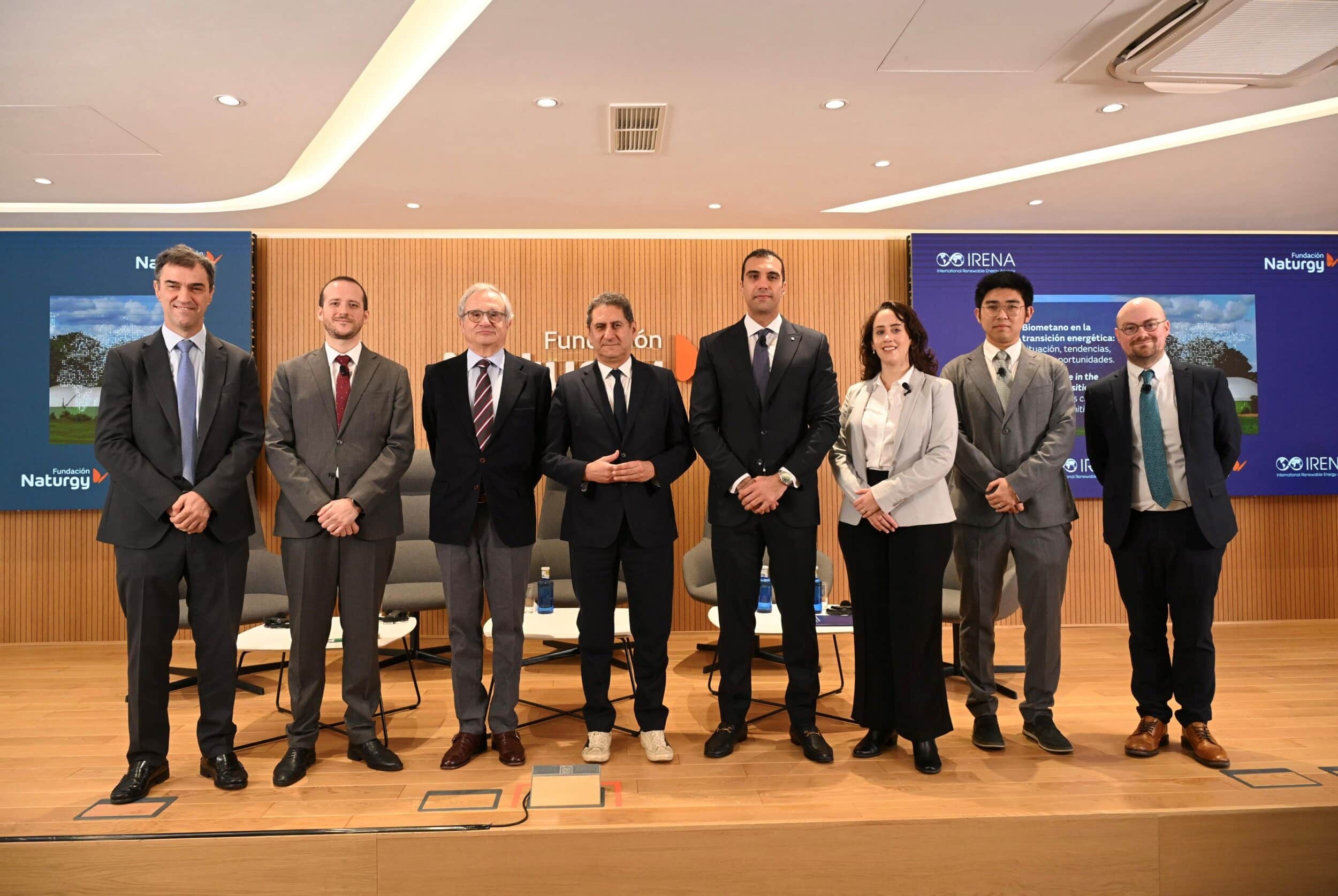
The session, moderated by Pablo Bronte, editor of Montel Iberia, began with a presentation from IRENA on the current state of the global energy system, with a focus on the dominance of renewable electricity. James Walker, Renewable Gases Leader at IRENA’s Innovation and Technology Centre, emphasised that to meet 2050 international climate commitments, renewable capacity must triple by 2030 and increase by up to nine times by 2050 relative to 2022 levels. Although the mass electrification scenario is promising, some hard-to-abate sectors can benefit from biomethane as an attractive solution to decarbonise operations. Karina mentioned that “in sectors where direct electrification can be difficult or expensive, such as glass, steel, aluminium, heavy-duty transport or even the maritime sector, biomethane acts as a complement to electrification”
One of the central questions raised was how biomethane is expected to grow as governments push for decarbonisation and how critical the public sector is in that growth. The answer is clear: sustainability and the circular economy are no longer aspirational targets but central pillars of climate strategies worldwide. Where policy provides clarity and direction, biomethane scales; where uncertainty persists, progress slows.
Globally, the sector is expanding rapidly, though unevenly. Europe remains the dominant region, with around 1,620 biomethane plants and approximately 7 bcm of annual capacity. The United States produces about 3.6 bcm, India around 3.2 bcm, and Brazil roughly 0.8 bcm, with additional capacity predicted from 2026 to 2028. According to the International Energy Agency, global biogas production is expected to grow by about 22% between 2025 and 2030, with particularly strong acceleration in emerging markets such as Brazil, India, Indonesia, and China.
Yu Yuan, deputy secretary general and senior researcher at the Association for the Promotion of Bioenergy Industry and the Chinese Association for the Promotion of Industrial Development, emphasised that there is growing interest in biomethane in China, mirroring the global trend. Industrial offtakers such as AstraZeneca are endeavouring to reduce emissions by procuring biomethane.
He also stated that “the construction policy the Chinese government has established has very tough targets for industrial parks, which must be 100% green energy if they want to qualify as zero emission parks and I think this is the best way to support this economy”.
Policy, infrastructure, and demand are the pillars of a thriving industry. In regions with extensive gas networks, grid injection enables cross-sector decarbonisation. In areas with limited infrastructure, transport and local industrial use often provide the most effective pathways. Increasingly, energy companies and corporate offtakers are investing in biomethane to meet decarbonisation targets, reduce emissions across value chains, and offer certified green gas products to customers.
The economics of biomethane have improved due to carbon pricing, volatility in fossil fuel prices, technological advances, and rising demand for low-carbon fuels. Nevertheless, public support remains essential, particularly in early market stages.
Mohamed Alaa, energy expert at the Energy and Climate Action Division of the Union for the Mediterranean Secretariat, noted that countries such as Egypt, Morocco, Turkey, and Jordan are already incorporating biomethane into their energy strategies.
Takeaways:
The discussion in Madrid reinforced that biomethane is not a niche solution but a strategic pillar of the energy transition. As the global scenario evolves, sustaining momentum will depend on three interlinked dynamics:
First, how decisively governments create enabling environments. Clear targets, long-term regulatory visibility, streamlined permitting, and robust certification systems reduce investment risk and unlock capital. Biomethane delivers multiple public benefits simultaneously: emissions reduction, waste management, rural development, and energy security, making it one of the few solutions that can address climate, economic, and social objectives in parallel. Governments that recognise and monetise these co-benefits through carbon pricing, renewable gas mandates, or support schemes will accelerate deployment at scale.
Second, how effectively markets align infrastructure, policy, and demand. Biomethane’s value lies in its compatibility with existing systems. It leverages existing gas grids, transport logistics, and industrial assets to enable rapid decarbonisation without stranded infrastructure. However, misalignment, such as production incentives without grid access or demand without certification, can stall growth. Integrated planning across energy, agriculture, waste, and transport sectors is essential to ensure feedstock availability, grid readiness, and stable offtake markets.
Third, how the private sector recognises biomethane as a cost-effective, ready-to-deploy decarbonisation tool, and uses its influence to shape regulation. Biomethane offers an immediate pathway to reduce Scope 1 and Scope 3 emissions without requiring major technology shifts. As more companies commit to net-zero targets, their demand for certified renewable gas can create powerful market signals. When industry advocates for clear standards, guarantees of origin, and supportive policies, it can accelerate regulatory development and market maturity.