

India’s cooking gas crisis and the case for biogas: a strategic opportunity for energy security
Arti Gupta, WBA India Country Manager considers the three key factors converging to create an ideal moment for biogas:
- Crisis: LPG shortages are pushing the search for alternatives.
- Technology: Modern, scalable biogas systems are now available.
- Economics: Financial incentives, such as carbon credits, make biogas investments attractive.
Exposing Structural Dependence
India is currently facing a cooking gas (LPG) crisis exacerbated by global geopolitical tensions and supply chain disruptions arising out of the Middle East conflict, revealing a troubling reliance on imported fossil fuels. Despite the promotion of schemes to promote clean cooking like Ujjwala, a significant portion of LPG remains imported, leading to severe shortages and rising prices, particularly affecting rural and semi-urban households.
Amid this crisis, biogas – a long-neglected energy solution – is re-emerging as a viable alternative, promising local production and energy security.
The Forgotten Promise of Biogas
The development of biogas in India began in the late 1950s with the pioneering work of Dr. Ram Bux Singh, who established the country’s first “Gobar (biogas) Gas” plant and introduced innovative fermentation technologies. This laid a crucial foundation for future advancements in the sector.
In the 1980s, the launch of the National Project on Biogas Development (NPBD) marked a significant turning point, promoting biogas as a viable alternative energy source for rural households through subsidies and financial support. Notably, the introduction in 1984 of the cost-effective fixed-dome micro-biogas plant known as the Deenbandhu model enabled easier adoption of biogas technology using local materials.
Despite facing challenges in subsequent decades, these early efforts cultivated a renewed interest in biogas as a sustainable energy solution, vital for addressing India’s contemporary energy challenges and enhancing rural sustainability.
The Present LPG Crisis: A Turning Point
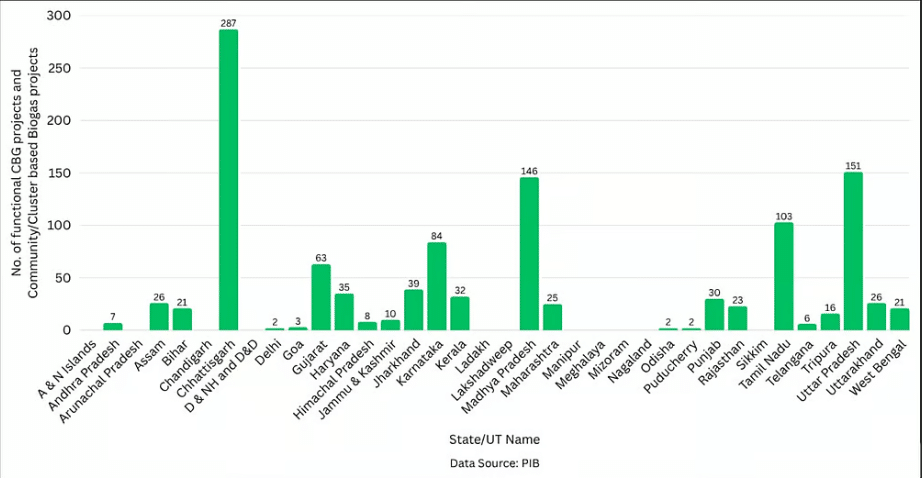
Today’s LPG shortages are a crucial turning point. Reports of black marketeering and supply gaps have prompted communities to revive old small and medium scale biogas systems while new bio-CNG clusters are being established, signalling a structural shift toward decentralised energy solutions.
The Government of India is now actively supporting small (1–25 m³/day) and medium (25–2500 m³/day) biogas plants that promote local production and consumption, significantly reducing the country’s dependence on imports. These plants can replace 1–2 LPG cylinders per month per household, providing a consistent fuel supply from daily waste.
Technological Advances
The modern biogas landscape is vastly different from that of the 1980s. Today’s systems increasingly use prefabricated, modular digesters and produce biogas that can be used in multiple ways depending on the application. Raw biogas is commonly used on‑site for clean cooking, heating or electricity generation through combined heat and power (CHP) systems.
At larger scales, biogas is upgraded to biomethane – also known as compressed biogas (CBG) when compressed, which matches the quality of CNG and can be injected into gas grids or used as a transport fuel. In India, strong policy support is accelerating this growth, including the government’s Sustainable Alternative Towards Affordable Transport (SATAT) scheme and proposed mandates for CBG blending into national and city gas grids.
Economic and Social Impact
Biogas has become increasingly bankable, not just as an energy source but also as a climate asset, with revenue potential from carbon markets further enhancing its appeal. Each tonne of feedstock can lead to a CO₂ reduction of about 2.83 tonnes. A dual revenue model – gas sales and carbon credits (just being introduced) – makes biogas projects financially attractive for private investors.
Transitioning to biogas can lower fuel costs for households and empower rural communities through job creation and improved sanitation. For India as a whole, it represents an opportunity to reduce reliance on LPG imports and strengthen energy security.
The way forward: A National Mission
To effectively scale up biogas, India should focus on cluster-based village systems, leverage financing from banks and carbon markets, and encourage private sector participation. Integration of existing schemes can accelerate deployment.
India’s LPG crisis underscores the urgent need for energy independence and sustainability. Biogas presents a viable solution, offering a pathway to decarbonisation and revitalising indigenous energy systems. The historical development of biogas highlights its potential to enhance energy security and promote environmental sustainability.
With the right investments in technology, supportive policies and a focus on economic viability, now is the pivotal moment to harness biogas and shape a sustainable energy future for India.